Institutional Rigor.AlternativeAdvantage.
Institutional-grade alternative investment access for independent financial advisors — powered by Fortis Capital Advisors.
The Case forAlternative Investments
Alternative investments have historically provided superior risk-adjusted returns, reduced portfolio volatility, and access to return streams uncorrelated with traditional markets. Institutional investors have long recognized this advantage — now independent advisors can too.
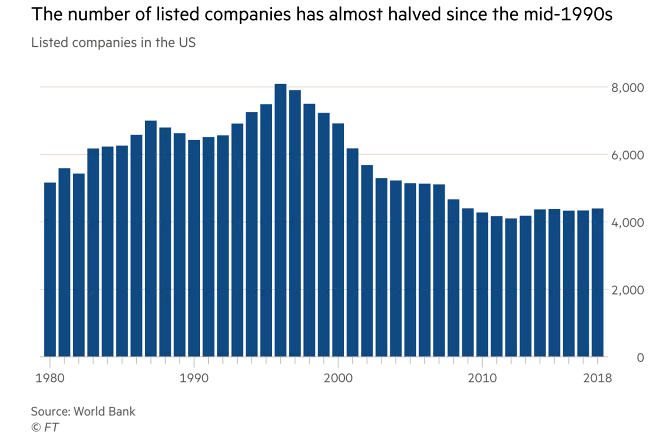
The Universe of U.S. Listed Companies Has Shrunk Dramatically
Alternative investments have become a significant growth area within the financial services industry for one very good reason – the number of publicly traded companies has declined by 40% since 2006 as companies are staying private longer. Thus, investors opportunity sets have been vastly diminished if they limit themselves solely to the public markets.
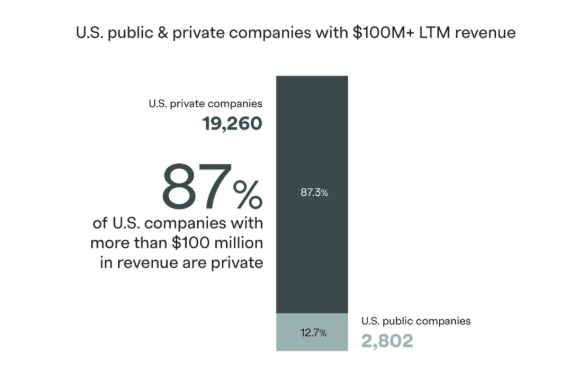
Private Companies Now Generate the Majority of U.S. Revenue
Private companies account for approximately 66% of U.S. business revenues, yet most retail and advisory portfolios have zero exposure to this segment. The economic engine of America is increasingly private — and portfolios should reflect that reality.
- 66% of U.S. business revenue is generated by private companies
- Public markets represent only a fraction of total economic activity
- Excluding private markets means missing the dominant share of growth
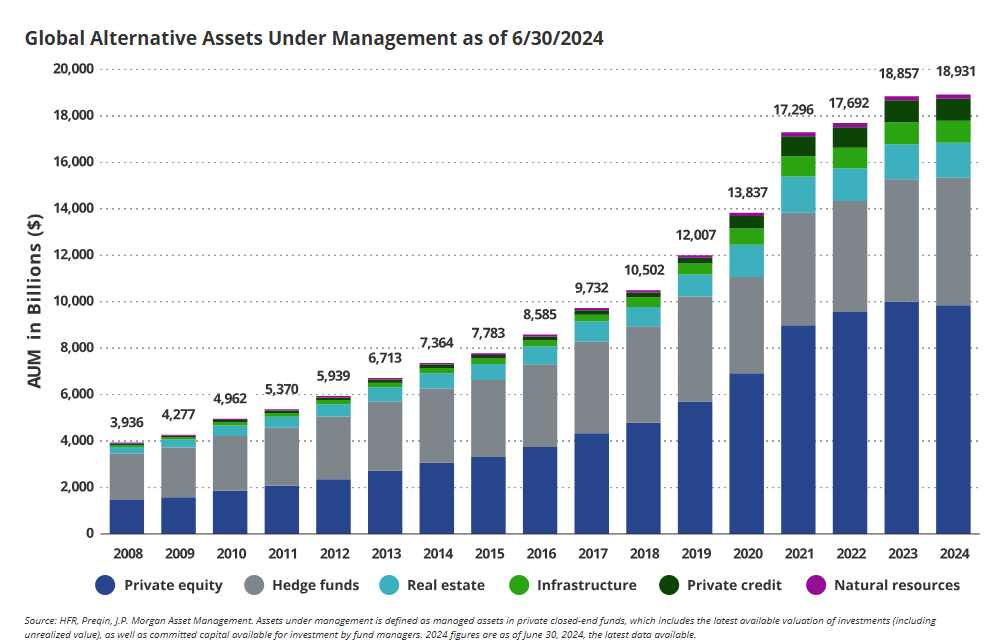
Global Alternative AUM Has Grown to over $20 Trillion
Institutional capital has been flowing into alternatives for decades. Global alternative assets under management have grown from roughly $4 trillion in 2008 to over $20 trillion today — a testament to the risk-adjusted return potential that sophisticated investors have long recognized.
- AUM has more than tripled since 2008 across all alternative categories
- Private equity, private debt, real assets, and infrastructure all expanding
- Institutional adoption validates the long-term case for alternatives
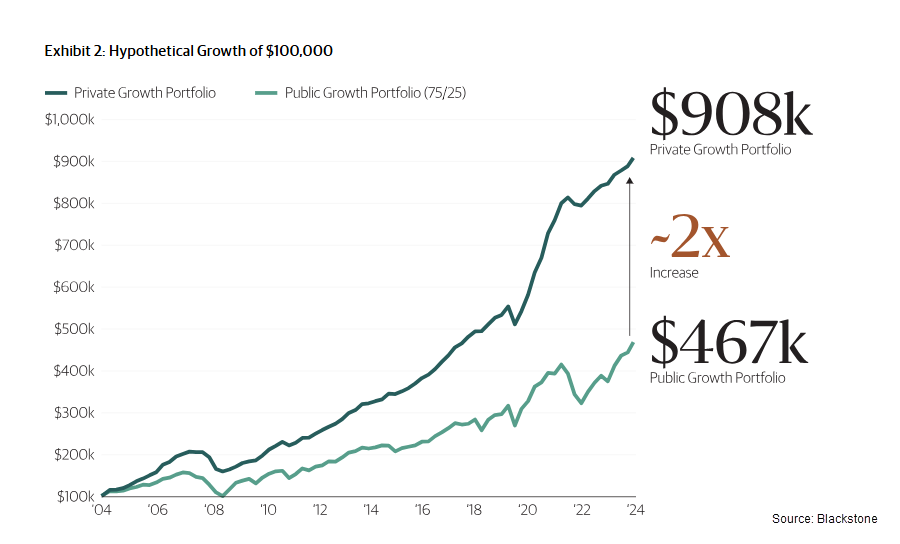
$908K vs. $467K — The Cost of Ignoring Alternatives
A $100,000 investment in a portfolio with private market allocations would have grown to approximately $908,000 over the past two decades — nearly double the $467,000 outcome of a traditional 60/40 portfolio. The compounding advantage of alternatives is significant and measurable.
- Nearly 2× the terminal wealth versus a traditional portfolio
- Outperformance driven by private equity, private credit, and real assets
- The gap widens over time as compounding amplifies the return differential
Alternatives Improve Both Returns and Volatility
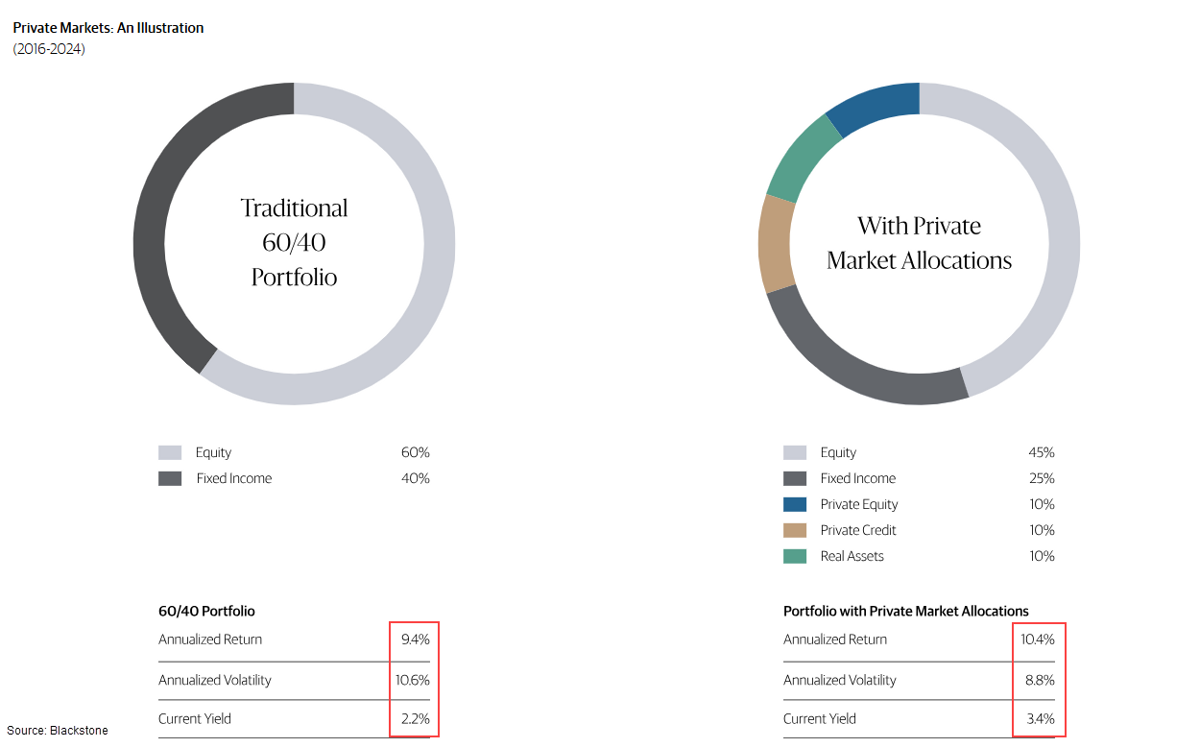
One very important added benefit of alternatives when compared with a traditional 60% equity and 40% fixed income portfolio, is that a private market portfolio can take advantage of uncorrelated returns which positively impact both portfolio returns and volatility. In this example, adding alternative investments has resulted in an almost 100 basis point improvement in return and yield metrics, while annualized volatility has declined substantially.
Alternatives Shift the Efficient Frontier in Your Favor
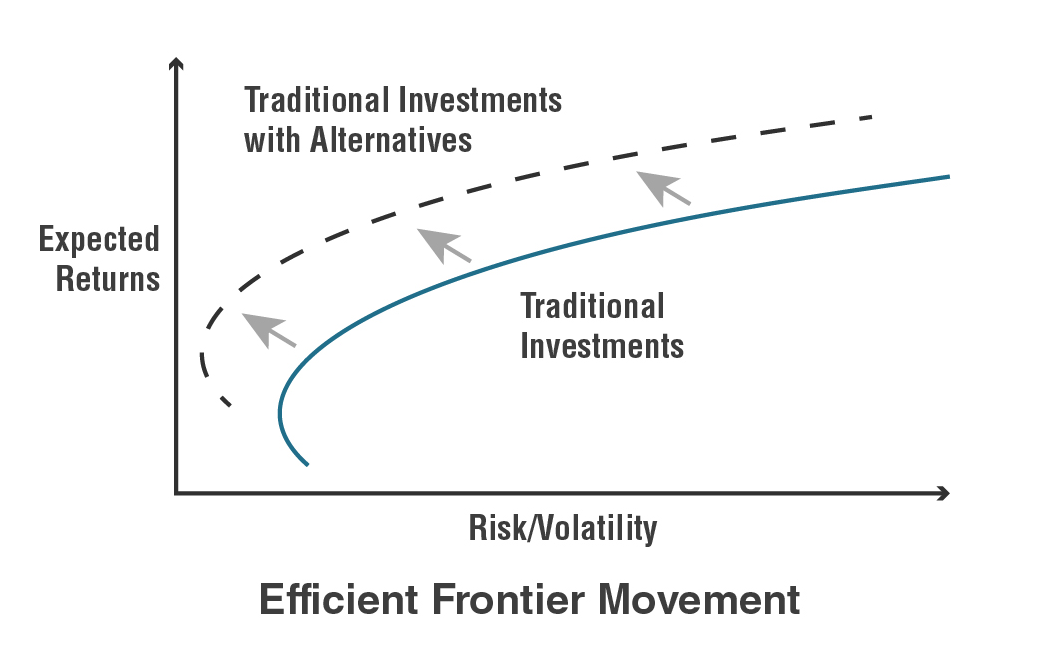
Modern portfolio theory demonstrates that adding low-correlation assets expands the efficient frontier — enabling portfolios to achieve higher expected returns at any given level of risk. Alternatives are the primary lever institutional investors use to move beyond the constraints of a traditional stock-and-bond portfolio.
- Shifts the risk-return frontier upward and to the left
- Enables higher returns without proportionally increasing risk
- The theoretical foundation behind institutional portfolio construction
Rising Correlations Limit Traditional Portfolio Diversification
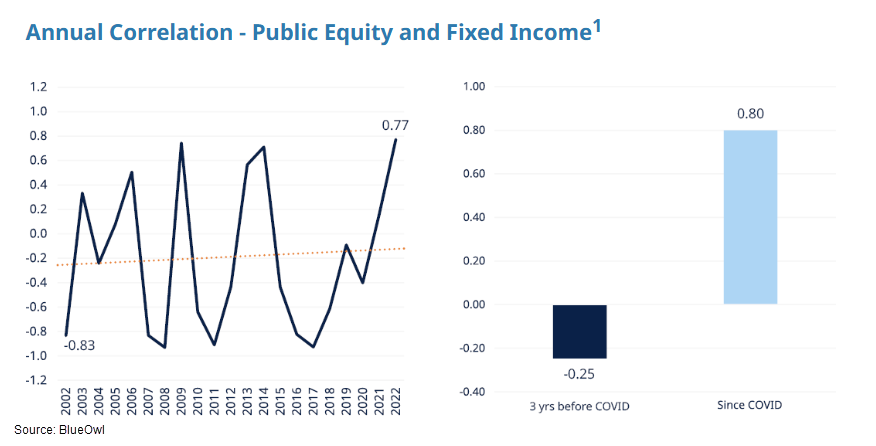
Interestingly, a big source of negative correlation between public equities and fixed income has been the occurrence of a multi-decade bond bull market which saw yields decline substantially. With this secular trend now in the rear-view mirror, correlations between public equity and fixed income have been increasing and thereby limiting the diversification benefits of a traditional 60/40 portfolio.
Alternatives Are as Diverse as the Private Economy
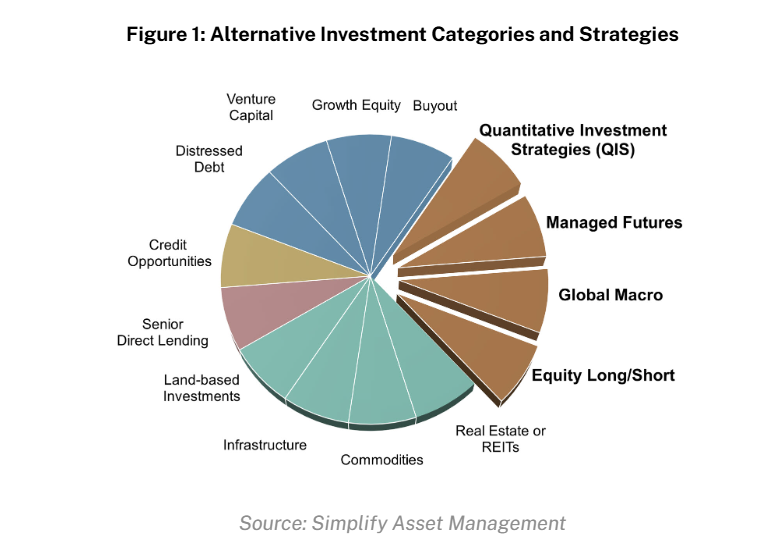
Private markets can also provide unique investment opportunities by allowing early participation in meaningful secular trends in specific economic sectors like the AI buildout, digital economy or life sciences/biotech. Alternative investments can also provide access to specific property types, infrastructure, or geographic regions that can further differentiate return/risk profiles. In short, alternative come in many different flavors and are as diverse as the private economy.
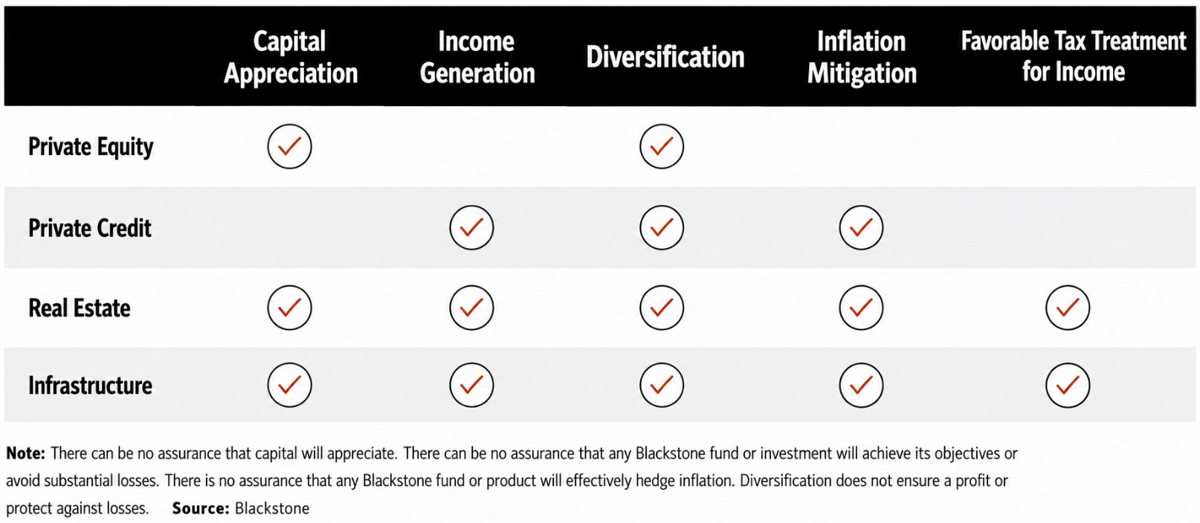
Private Markets Cover the Full Spectrum of Financial Objectives
As with public markets, investors can pursue specific financial objectives using private markets that cover the spectrum from capital appreciation through income generation and tax avoidance. Bespoke opportunities within private markets can be tailored to individual's interests and/or values.
The Challenge of Investing in
Alternatives
Investing in alternatives is not without its challenges and requires access to a broad universe of opportunities, the insight to select the appropriate vehicles as well as appropriate levels of due diligence on both managers and the investment specifics. And, as with most investments, a good deal of patience can also be required.
Bottom line, without careful due diligence and management, investors may struggle to separate true sources of alpha from strategies that simply add cost or risk.
Complexity and opacity: There is a wide dispersion of manager skill and limited transparency.
Liquidity constraints: Investors need to have longer investment horizons and expect reduced flexibility.
Higher costs and fees: Managers will charge more for specialized strategies and structures that may or may not be acceptable to the investor.
Operational demands: Private market investing requires greater due diligence, monitoring, and analysis of integration risk.
Institutional Pedigree.Advisor-Centered Design.
Timber Point Capital Management bridges the gap between institutional alternative investment management and independent financial advisors — delivering the depth, discipline, and resources of a major institution without the constraints. Powered by Fortis Capital Advisors.
Institutional Process
We apply the same rigorous investment process used by major pension funds and endowments — bringing institutional discipline to independent advisory practices.
Curated Manager Selection
Access to a carefully curated universe of top-tier alternative managers across private credit, hedge funds, real assets, and private equity.
Manager Due Diligence
Comprehensive operational, quantitative, and qualitative due diligence on every manager — protecting your clients and your practice.
Portfolio Integration
Seamless integration of alternative allocations into existing client portfolios with sophisticated modeling, risk analysis, and ongoing rebalancing.
Simplifying Complexity
We translate complex alternative investment strategies into clear, client-friendly narratives — making it easy to communicate value to your clients.
Fiduciary Standards
We operate under the highest fiduciary standards, ensuring every recommendation is made in the best interest of your clients — always.
Proven Value of Alternatives
Decades of institutional data demonstrate that properly allocated alternatives enhance portfolio outcomes — we bring that evidence to your practice.
Operational Efficiency
Streamlined subscription, reporting, and compliance workflows reduce the operational burden of alternatives — freeing you to focus on client relationships.
Frequently Asked Questions

TPCM Alternatives Introduction
Timber Point Capital Management
TPCM Alternatives Q&A
Hear directly from the Timber Point Alternatives team on how alternatives can benefit your portfolio, our process and how we partner with advisor's to deliver institutional grade solutions.

Manish Shah, JD
Head of Alternatives
Alternative investments are asset classes beyond traditional stocks, bonds, and cash. They include private equity, private credit, hedge funds, real estate, infrastructure, and commodities. These investments typically offer lower correlation to public markets, potential for enhanced returns, and diversification benefits that can improve overall portfolio risk-adjusted performance.
OUR TEAM
Institutional Pedigree. Advisor-Centered Design.
Institutional background across pensions, endowments, and UHNW. Supported by a multidisciplinary team with expertise in institutional research, portfolio construction, alternative investments, and client service.

Click to read bio
Manish Shah, J.D.
Head of Alternatives

Click to read bio
David Cleary, CFA
President & Chief Investment Officer

Click to read bio
Patrick Mullin, CFA
Partner & Managing Director

Click to read bio
Karol Krucinski, CFA
Portfolio Director
Click to read bio
Victor A. Canto, Ph.D.
Economic Consultant

Click to read bio
Diane DeCaprio
Operations Manager
Timber Point Capital Management
Identifying where institutional alternative investment resources can complement your existing capabilities.
Office Location
4 Westchester Park Drive
Suite 100
White Plains, NY 10604-3431
Phone
(914) 898-3038Website
www.timberpointcapital.comRequest More Information
Schedule a 30-minute working session to explore how TPCM Alternatives can complement your practice.